
I am not pulling any punches in this blog and it is probably going to sound negative until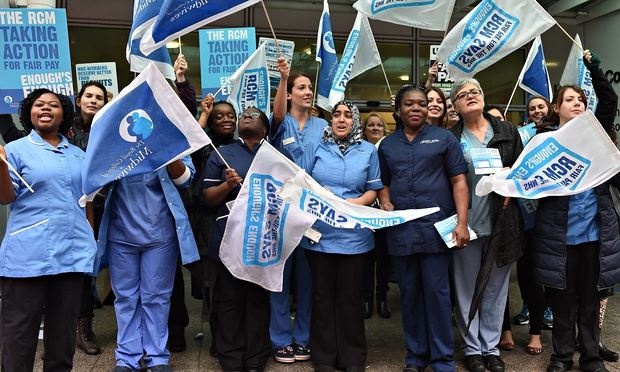 you reach the end! This week we have seen staff in the NHS striking over pay and working conditions. For those in the caring professions, it is a huge thing to strike and I know many colleagues who did some serious soul-searching before they took this action. There is a difficult truth for us to face as a nation in the UK (and especially England). What many consider to be the nation’s greatest treasure is on its knees. Although the NHS has been in huge profit in the last few years, this money has not been reinvested into healthcare. Our democratic processes are null and void and the vox populi has been silenced. (photo taken from the Guardian -Andy Rain).
 Although we have, without a doubt, the finest health system in the world in terms of value for money and good outcomes for all, we have reached our peak and we are now on the downward slope of a bell curve and are beginning to fall quickly. This is happening due to a heady cocktail of:
1) Centralised government and other power structures making target-driven policies which commodify human life into biopower and in so doing, dehumanise people. Westminster deciding on how a health budget should be spent across Morecambe Bay is nonsensical. Local people need to be far more involved through a process of regional assemblies and participatory economics. Morecambe Bay does not have the same health needs as London and having Westminster-centric targets is not working.
2) Paucity of funding. The overly expensive reordering of the NHS has not saved any money, and a system which was naturally creating surplus did not have that money reinvested. With our increasing health needs, we will soon have a £30billion shortfall….However, we also spend less on health overall than most European nations and could absolutely choose to invest more in health, if we didn’t keep going to wars which in the long run are not going to bring the peace we long for.
3) Burnt out staff – in my opinion, the strike was not so much about a lack of pay, but more about a lack of honouring, recognition, thanks and protection for staff who pour themselves out lovingly on a non-stop basis, usually without a break, for 13 hour shifts and are then expected to do overtime and asked to claim that time back in annual leave, but then never actually being given that leave! The system has been abusing its workers and the workers are no longer able to stand up under the weight of the pressure. Ongoing low morale and a sense of increasing burdens is unsustainable.
4) Early retirements – in my opinion, changing the pensions was unavoidable. However, it has led to a mass exodus of people from the NHS at the age of 55, and over the next 3 years we are going to lose an enormous percentage of our GPs nationally as a result. This has been ill-thought through by the government and has left us with a massive staffing crisis.
5) Lack of investment in training – putting it simply, we’re not training enough doctors and nurses for the future. The government know this, but were hoping to get cheaper labour from elsewhere.
6) Better offers overseas – for young doctors qualifying in the UK, 25% are leaving after their second year in practice due to the pressures involved and many are heading overseas to warmer climates and better pay packages. I could earn more than double what I earn now in Australia or Canada, for many less hours worked and a higher quality of life. Now, for me those aren’t driving factors, but I can understand why for some the move abroad is evermore attractive.
7) High patient demand – the amount of problems people now run to their GP or A&E department with is becoming ridiculous. We have embraced a learnt sense of helplessness and disempowerment, ever worsened by media-driven health anxieties.
8) An elderly population – due to the breakthroughs which have happened in health care, we are living for longer. But with increasing age comes increasing frailty, increasing health problems, increasing medications with their subsequent interactions and increasing social care needs. It is wonderful that people live long, but it adds to the picture of a health service under strain.
9) Worsening morbidity – we have to face facts that as a nation, we are becoming more unhealthy and more obese. We eat far too much sugar, we don’t exercise nearly enough, we have high stress jobs and broken relationships. We have not promoted healthy living. En masse, we have lived exactly as we’ve pleased but then expected the NHS to fix our health problems……
10) Competition between primary and secondary care – the NHS is funded in a totally bizarre way. Competing for funding rather than having a system in place which enables partnership and integration makes no sense at all.
11) Too many silos – following on from the point above, we have too many different organisations within the NHS which work in silos, resulting in systems which communicate poorly with one another and a pathetic IT system which does not talk across these organisations in any meaningful way. This segregation puts a huge strain on services and so often stops us doing the very thing we hope to do. Having a CCG, an acute trust, a mental health trust, community nursing, a hospice, nursing homes, social care and public health -now under the care of local government all working separately and competing for resources is nonsense.
12) Increasing mental health needs – let’s make no mistake about it, mental health needs are increasing and very poorly cared for currently. We have increasing anxiety and depression (worsened by the austerity measures) with waiting lists of services like CBT at ridiculous levels. We have more patients developing dementia and needing extra care.
13) Crippling debt, due to the idiocy of using PFI’s in hospitals, meaning that most acute/foundation trusts are in a continual financial nightmare.
We must break down the facades that keep on pretending everything is ok and that we can sustain things just as they are.
Is there any hope? Oh yes! There is plenty of it and not without good reason. But we are going to have to break ourselves out of apathy and out of the hypnotisation of our lives in which we get up go to work, come back, switch on the telly and don’t engage with the issues of our day. We are also going to have to be brave enough to accept the fact that we are post-nhs as we have known it and embrace together some holy experiments. We need to find new partnerships and integrated interdependence based on the wonderful foundations of free healthcare for everyone, protecting the needs of the most vulnerable remembering above all that healthcare is a service not a business. More on this anon!

 reimaginingthefuture