An Open Letter to Theresa May, Home Secretary

Dear Theresa

I hope you don’t mind the informal greeting, as I’ve never had the opportunity to meet you, but I believe in a level playing field when it comes to communication and I find that titles can get in the way of that. I also wanted to use your first name, because it is somehow more human and I want to appeal to you as a fellow human being, before addressing you as our current home secretary. There is a very high probability that you will never read this, so I thought I would write it as an open letter to engage others in a vital conversation.

The reason for my letter is to appeal to you on behalf of the hundreds of people you are currently detaining in any one of the 11 Detention (Immigration Removal) Centres located throughout the UK. There have been several reports of the dreadful treatment of fellow human beings, people we call our brothers and sisters, in this wide and varied family of humanity. Even your chief inspector of prisons calls the conditions ‘appalling’. Many of these people have been victims of torture and abuse from which they have fled only to be treated in a simply disgusting way in this nation. You are even detaining pregnant women and children (141 children that are known of in the last 5 years). These beautiful human beings are treated in an altogether sub-human way.

Georgio Agamben writes of the ‘State of Exception’. I’m sure you are aware of his writings, but if not, this ‘state of exception’ describes how a human being can be both simultaneously bound and abandoned to law. It reveals what really undergirds a nation; that which we are willing to put aside to maintain the status quo. The detention of people in this way reveals a vile underbelly and a rotten foundation to this nation state. These detention centres are our very own example of Guantanamo Bay, where people are held without hope of a fair trial, justice or human kindness. Essentially, by keeping people who are deemed to have failed in seeking asylum in these detention centres, you “erase any legal status of the individual, thus producing a legally unnamable and unclassifiable being.” (Agamben, State of Exception p7). To treat any person who does in fact have a name and a face in such a manner, is altogether inhumane and utterly wrong.

In our house, we try to live with the following kind of philosophy:
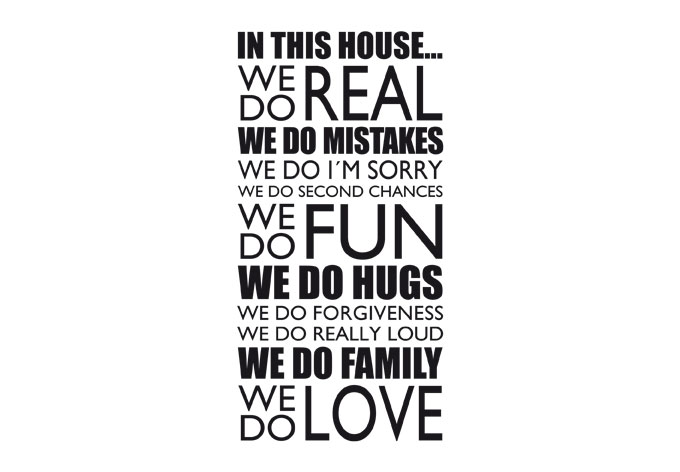
In this house

As home/house secretary, I wonder if you think the home/house we are creating in this land is reflected in these removal centres? I know you will argue that this land isn’t their home, which is why we are sending them back to their country of origin (which I doubt they could really call home or they would not have fled it). But there is something so very wrong about how you are allowing them to be treated. You know fine well from serious case reviews that terrible errors have been made in sending people back to their country of origin, leading for example to the death of a lesbian woman in Uganda. You know there have been and continue to be atrocious abuses of basic human rights in these detention centres. You know that people are being denied access to vital medical treatment (www.medicaljustice.org.uk). You know that at least one person has been unlawfully killed at the hands of your profit making making friends, G4S, who run these centres for you. Yet you are allowing it to continue. Theresa, how is this loving? How is it kind? How is it human?

I am sure your job is filled with complications and difficult decisions, and I am sure that there are some who may well need deporting to another land, but do not let the office you hold become separate from your humanity. I appeal to you as a fellow human and I appeal to you as the home secretary to do an urgent review of these centres.

I would like to suggest the following:

1) Please would you spend a day in each of detention centres and simply hear the stories of those you are detaining there. Then please look them in the eye and justify your decision to allow them to be treated as sub-human.

2) Please remove G4S from the management of the detention centres, as they have demonstrated a recurrent lack of love or concern for human welfare.

3) Please consider that detention centres could be managed instead by asylum charities, who have a far better understanding of the needs of those they would be caring for and can ensure that they are given appropriate access to legal help and medical intervention. This can be backed up with security if needed, but by changing the environment and approach of how we ‘detain’ people, I imagine we will have less security issues.

Thank you for taking the issues of human love and justice seriously,

Yours most sincerely

Andy Knox

Complex Very Complex

A brilliant midwife, whom I hugely respect, posted this link on her Facebook page recently (if you don’t have time to read it, it details how North Wales is going to lose its special care baby units, so babies needing such care will be transferred over to England):

http://www.dailypost.co.uk/news/health/baby-care-shake-up-more-north-6720586

When we lose local services it causes a sense of anger and disempowerment. What about not being able to give birth in your local area, if you have a complex pregnancy? What if a mum’s baby is taken miles away from her for special care, only hours after having a caesarian section and it is a few days before they are reunited? What is the impact of this on the mental health of the mum and child? What about partners who can’t afford to keep travelling 40-50 miles to visit mum and baby and have to look after the other kids? What about the loss of jobs to the local economy and the sense of belonging that having things available in the local community can bring? What about the dangers of being transported to somewhere so far away to receive specialist care? It seems like a dreadful and unloving thing to close local services.

Sadly, it’s not that straightforward…. I thought it was, until I became the lead clinician for maternity for Lancashire North CCG. When looking to provide services for an area we have  a backdrop of three key factors to consider: 1) Safety, 2) Affordability, 3) Accessibility.

1) Safety: Research suggests that survival rates of babies with complex needs are higher in specialist tertiary centres, which deal with such problems far more commonly. Travel times from studies seem comparatively safe. Women, who have complex pregnancies have better outcomes in more specialist environments. The equipment is better, staff are more specifically trained and due to seeing and dealing with very poorly babies and mums more often, the care is better and survival is higher. Currently, the UK has some of the worst maternity and neonatal data in Europe and there is a hope to change this. I am grateful that none of my children needed this kind of care when they were born. I was also grateful, that if they had, I happened to live in Manchester where there is some of the best care available in the UK. But there is a difficult question for those who live more rurally (as I now do). If your pregnancy is complicated and you need more specialist obstetric input, or your baby needs highly specialised care, do you want that care to happen locally with a team who may not have lots of experience in that specific situation, or would you rather be transferred, potentially some distance, but be able to receive more expert care and have better long term health outcomes?

2) Affordability: Currently in the UK, the litigation budget for maternity and neonatal care takes well over 40% of this whole budget area. They are also hugely expensive specialities. We would all love to have highly specialist units on our doorstep or at least fairly local. But we have to face to some difficult facts that we have a lot of hospitals in the UK, which are extremely expensive to run and we can’t afford them all to be specialist centres for everything….We don’t have the staffing levels needed for this and with the way we currently do economics and due to our strong culture of blame and litigation when things go wrong, we don’t have the money. We have also hugely over-medicalised birth as a process. The Midwifery 2020 document implores us to help birth become a more natural process again, to take out too much over involvement and encourage (more affordable) midwifery led units and home births…..We could also train our midwives and health visitors (and even surgeons) to higher levels of expertise, as they have done in Scotland…..Complex cases could then be handled in larger regional centres…..

3) So, when we talk about accessibility (and for me this is especially important for the marginalised poor and for those for whom mobility is a real issue), we have to have that discussion in the light of safety and affordability. We also need to factor into our budgets the need to help those who can’t afford travel and child care…..

This doesn’t stop with maternity and neonates. Only yesterday we have also seen the Health Secretary, Jeremy Hunt, decide to close large parts of Mid Staffordshire Hospital and redistribute services elsewhere, after the recent scandal involving substandard care. We are seeing ED’s closing and will see many more such ‘reorganisations’ happening.

I believe that leadership can be self-emptying and loving and sometimes hard medicine does not always feel like love. Personally, however, I feel that the way Mr Hunt acted was neither self-emptying or loving but rather dictatorial, bullish and driven by a very different ideological objective.

We do have some significant challenges ahead and there are some changes to our systems that are necessary in order to provide the most excellent and loving care. It will take some serious re-imagination and the breaking down of some current mindsets we hold.

Not that my opinion really counts for that much, but for what it’s worth, some of my ideas would be as follows:

I really believe in participatory economics (sounds fun, eh?!). There has been a lot of rhetoric about devolving of budgets and allowing local health boards to make decisions about how money is spent. Firstly this isn’t really happening, as any time a decision is made on something the ‘powers that be’ don’t like, they come and crush the idea and tell the boards what to do instead, with the threat that they will replace the board if they don’t comply! Secondly, it doesn’t go anywhere near far enough and it lacks integrity because there is no joined up thinking. If local people are going to make decisions about their local economy, then it must be the whole and not just a part. Currently we spend an enormous amount of money on treating disease (or preventing it through vaccinations), but nowhere near enough on promoting health in our communities. Isolated budgeting doesn’t work and we waste an enormous amount of time and resource. We know that maternity care and neonatal care are being made so much more complex by our astronomically rising rates of obesity and diabetes, but we’re not putting the money into the places that could help turn this tide. We are also not collaborating between areas like health and education but are rather putting them in competition with one another, which is genuinely crazy. So, if the people of North Wales want an amazing special care baby unit near by, which provides brilliant care, they could decide to do so, but there are cost implications on other services, and cost implications on keeping up the expertise of staff and giving them enough time and exposure to complicated scenarios to know how to handle them efficiently…..So, less learned helplessness, and more engagement…..

Within that, we need to watch out for selfishness and all wanting our own rights. For me there would need to be priority care for children, women, the marginalised poor (especially including destitute asylum seekers), prisoners, the elderly and the mentally ill.

I also believe in gift economics. Towns and cities within a region can gift things to one another. This is already happening in healthcare and could happen more and in many other fields. For example, in North Lancashire, Blackpool has a gift of cardiology and cardiac surgery. It is a regional centre of excellence. There was initial resistance and concern about losing and moving local services but survival outcomes after heart attacks and many other conditions, both in terms of mortality and morbidity (how well you are afterwards) are far better across the region. Preston has a gift of neurology and neurosurgery and again provide excellent care. We don’t all need to have everything. Learning how to work in partnership and collaboration is key.

We need less of a blame culture. We need more compassion and understanding when things go wrong. Even if all the complex care is put into regional specialist centres, things will sadly still go wrong at times, mums and babies will still be poorly and die sometimes and nothing will change this……so some would ask, is all the reorganisation therefore worthwhile?

The redesign of our current systems is necessary and complicated. Sometimes, in the face of the economic beast and within the suffocating nation state environment, we can feel hopeless of change and helpless in our learnt disempowerment. Foucault says that we’re not really disempowered…..we just think we are. Revolution doesn’t have to be violent and bloody. Revolution can occur when enough people chose to engage, to love and to become the change they want to see…..

In the mean time, my plea would be this. Let those who are making tough decisions do so out of love and goodness, and not look to make healthcare profitable for private company share holders. Secondly, let those who don’t make decisions be kind to those who do….

At What Cost?

I was handed a book this week entitled: “People over Capital” (the co-operative alternative to capitalism) and I’m looking forward to reading it on my way to Toronto later next week. The back cover starts with these words: “Economic turmoil, rampant inequality, austerity politics, climate chaos. Capitalism is clearly failing and ordinary people are being forced to pay the price. Faced with such deep-rooted problems there is real hunger for alternative ways of organising our economic systems.”  Increasingly I am becoming aware of the effect of what Foucault calls “biopower” or the commodification of life itself.

The film UK Gold has highlighted with insightful and expository brilliance the true relationship between the UK ‘democratic’ government and the corporate giants. If we’re not careful, we turn a blind to the cost of the cuts and the immense toll that the squeeze is really having on the little people. Whilst literally billions of pounds are being siphoned off into tax havens to bolster the super rich, we are making unbelievable cuts to our public services and welfare systems. The heartbreaking truth is that we are paying for this, not only financially, but people are being eaten up like bread, fodder for the economic machine that is destroying the very life we are made for. I know of two people in the last few days who sadly took their own lives under extreme pressures being placed on them as they tired to serve the public good – one a police officer, the other a social worker…….

I have blogged about ‘revolution’ and the need for something utterly and life-givingly different to what we have now, but I maintain that even in the face of the pain and sorrow, stress and strain that many find themselves in, the answer has never been and will never be violence. There is another way, and it is the way of love. We must love those who perpetrate these crimes against humanity. Our only hope is to forgive the wrong we are suffering and so find a better future for us all. How do we ‘turn the other cheek’ when we feel smacked in the face by an uncaring system that would squeeze the very life out of us for the sake of keeping the economy going? How do we give of ourselves lovingly in the face of such opposition and uncaring greed? How do we dance to a different rhythm than the dominant marching beat that sets it’s metronome to the whims of ‘market forces’?

Now is the time for creative experiments, like those of William Penn, before his sons sold out to greed and dominating hierarchy. These are days to love our enemies until there is nothing left for them except to love us back, as Martin Luther King demonstrated. We are in a moment of extraordinary potential. We must not rush, but take our time to let new hope, vision and pragmatic ways of reorganising ourselves to germinate within us. Kenarchy is about emptying out power, laying our lives down in love for one another, prioritising the dispossessed and radically renegotiating our relationship with money (sacred economics). We can remain as we are but the stark ongoing cost will be destruction, demoralisation and death. Or we can put on love, forgive the past, learn from it and embrace the future. It will cost us everything, but our hope is one of life.